AID-SpliceBase
AID-SpliceBase is a comprehensive, multi-layer database that combines multiple dimensions of transcriptomic data from autoimmune patient and control samples to analyze differential splicing events such as Alternative 3′ Splice Site (A3SS), Alternative 5′ Splice Site (A5SS), Mutually Exclusive Exons (MXE), Retained Intron (RI) and Skipped Exon (SE), differential transcript/isoform usage and, differential gene expression in control vs disease population. Alternative splicing and Isoform switching are fundamental post-transcriptional regulatory events that drives the overall transcriptome diversity and can greatly affect the immune homeostasis. Dysregulation in these mechanisms is increasingly recognized as a key driver of inflammation and pathology in autoimmune diseases.
Dataset statistics
Select a disease to see aggregated condition samples, or pick a specific dataset to view its condition distribution.
Isoform Switching in PSD4 in Rheumatoid Arthritis
In this example the gene PSD4 (Pleckstrin and Sec7 domain-containing protein 4), is traced in the synovial tissue transcriptome in RA disease condition.
(Normal, log₂ norm. counts)
(RA established, log₂ norm. counts)
Differential Gene Expression (DGE)
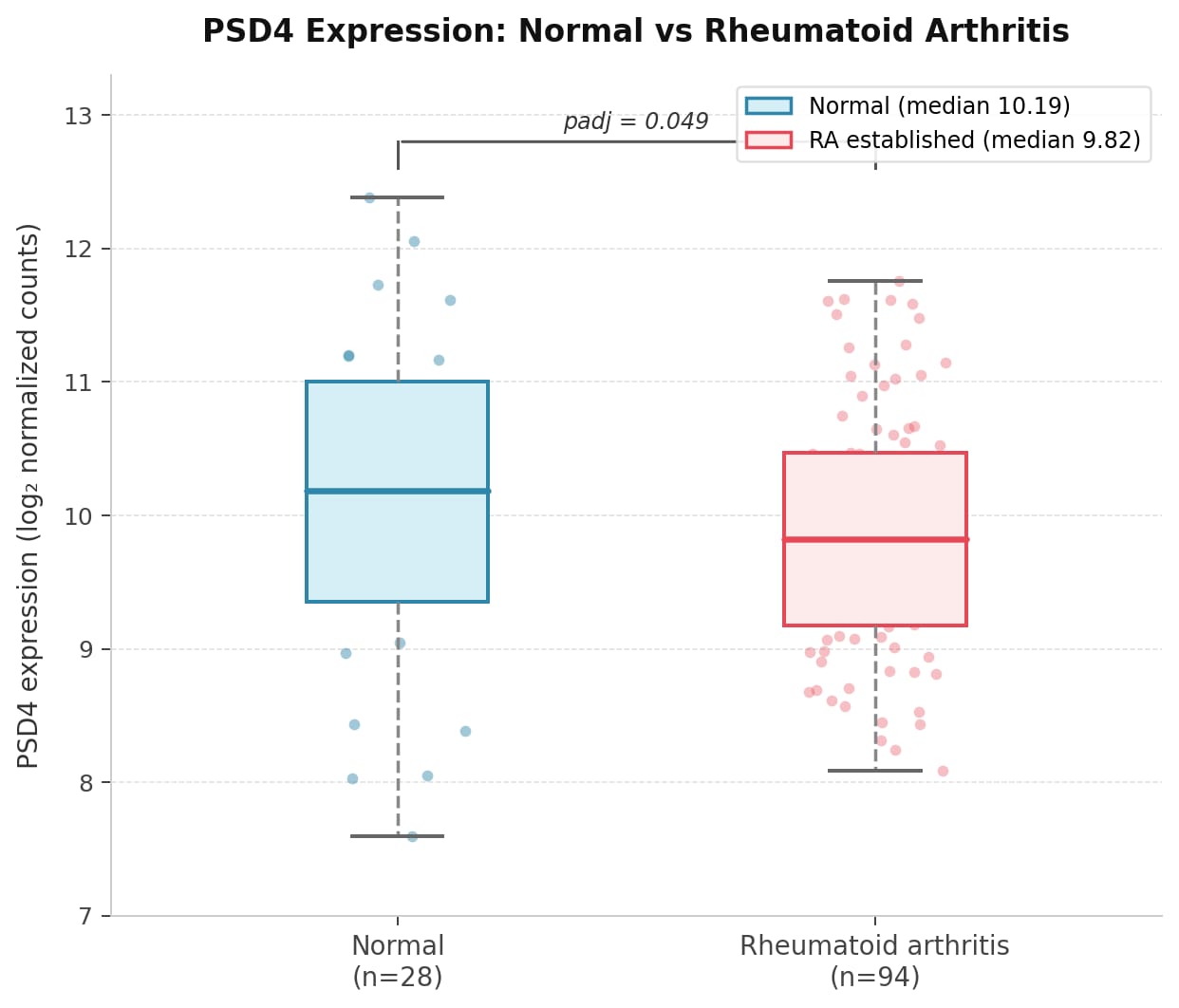
At gene level, when no alternative isoforms or splicing events are considered, box plot below shows that PSD4 expression is significantly lower in RA tissue (median log₂ = 9.82) compared to normal tissue (median log₂ = 10.19), with an adjusted p-value (padj) of 0.049 after Benjamini–Hochberg correction for multiple testing. The difference in medians of roughly 0.37 log₂ units, corresponding to approximately 24% less PSD4 transcript in RA. Gene-level summary like this can hide what is happening at the isoform level: total transcript abundance can remain near-unchanged while the splicing machinery directs reads toward a completely different isoform.